It reduces the need for technical intervention at individual sites.
It facilitates large-scale network deployments and minimizes manual errors.
It is particularly well suited to multi-site and SD-WAN environments.
Zero Touch Provisioning (ZTP) automates the configuration of a network device as soon as it is powered on for the first time. A Routeur, switch or firewall can therefore retrieve its settings remotely, without requiring a technician to perform a manual configuration on site. For IT teams managing multiple locations, ZTP primarily makes it easier to deploy standardized equipment while reducing on-site interventions.
What is Zero Touch Provisioning (ZTP)?
Zero Touch Provisioning enables a network device to automatically retrieve its configuration when it starts up for the first time.
The device starts with its factory settings, connects to the network, and then retrieves the information required to bring it into service. Depending on the architecture used, it can download its network settings, configuration, and certain software resources before joining the company's infrastructure.
The principle is simple: prepare configurations from a central location rather than configuring each device directly on site.
This approach is particularly well suited to the needs of multi-site companies, system integrators, and IT teams that need to deploy multiple devices with a consistent configuration.
What is the difference between ZTP and manual provisioning?
With traditional provisioning, a technician connects to each device to enter the required settings and verify its configuration.
With ZTP, the device automatically retrieves the configuration assigned to it as soon as it connects to the network.
This automation makes it possible to:
Reduce technical travel
Minimize repetitive data entry
Standardize configurations
Speed up the deployment of new equipment
How does Zero Touch Provisioning work?
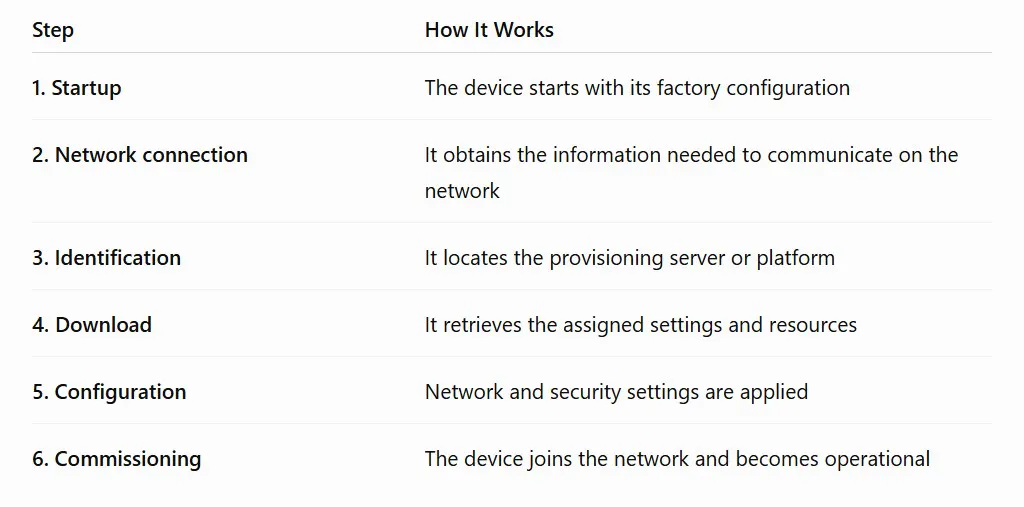
The exact way ZTP works varies depending on the equipment and manufacturers. However, the principle remains similar: the device connects to the network, identifies the provisioning service, and automatically retrieves the configuration intended for it.
The process can be summarized in six steps:
In some architectures, DHCP enables the device to obtain the information it needs to locate the configuration resources.
APIs can also connect provisioning to fleet management tools. For example, they can automatically assign a specific configuration to each device.
What are the benefits of Zero Touch Provisioning ?
The main advantage of ZTP is that it allows network equipment to be deployed remotely without requiring a specialized technician at every site.
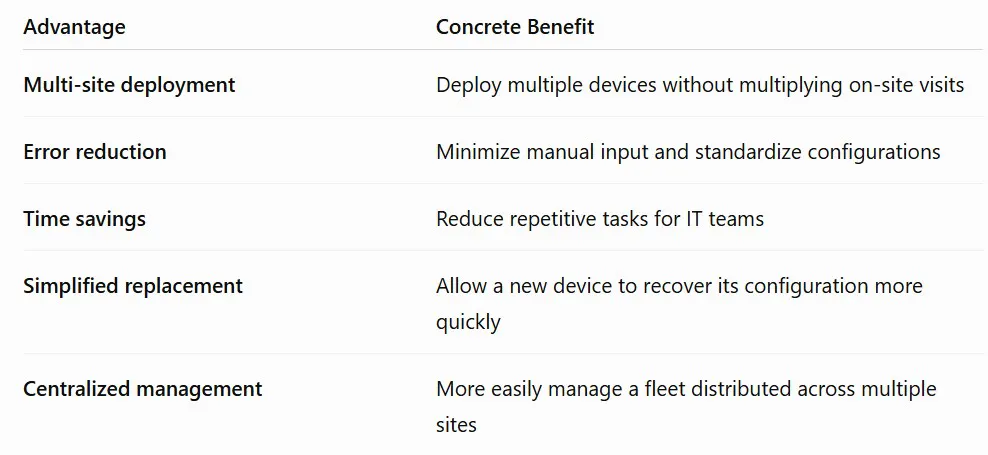
For a company managing multiple locations, this automation offers several tangible benefits:
Take the example of a company opening several retail locations. Network equipment can be delivered directly to each site, then connected and powered on locally. Its configuration is subsequently retrieved remotely.
Deployment therefore becomes more consistent while requiring less involvement from technical teams in the field.
Simplify the deployment of your multi-site networks
Centralize the management of your connections and adapt your network to the needs of each site.
Automation simplifies deployment, but it requires properly prepared and controlled configurations.
An error can be quickly applied to multiple devices. It is therefore important to test changes before deploying them at scale and to proceed in stages when the network environment is critical.
Security is also an important consideration. Since devices retrieve their settings remotely, communications and configuration files must be protected.
Several best practices can help secure the process:
Encrypt communications
Authenticate devices
Verify configuration integrity
Restrict access rights to provisioning tools
Test changes before rolling them out across the network
ZTP does not replace network expertise: it automates the execution of a configuration that must remain controlled, tested, and secure.
Why combine Zero Touch Provisioning with SD-WAN ?
SD-WAN is one of the most natural use cases for automated provisioning.
In a multi-site company, each branch, store, or location may have a network device associated with different access links, routing rules, and security settings.
ZTP simplifies the initial deployment of these devices. SD-WAN then makes it possible to manage connections and network traffic from a centralized interface.
To better understand this technology, see the definition of SD-WAN in the Sewan Glossary.
How Does Sewan Simplify Multi-Site Network Management?
Sewan's SD-WAN offering is designed to simplify the deployment and ongoing management of multi-site connections.
With Sophia, IT teams have access to a centralized platform for managing their Cloud and Telecom services. They can therefore access their services, configurations, and monitoring from a single environment.
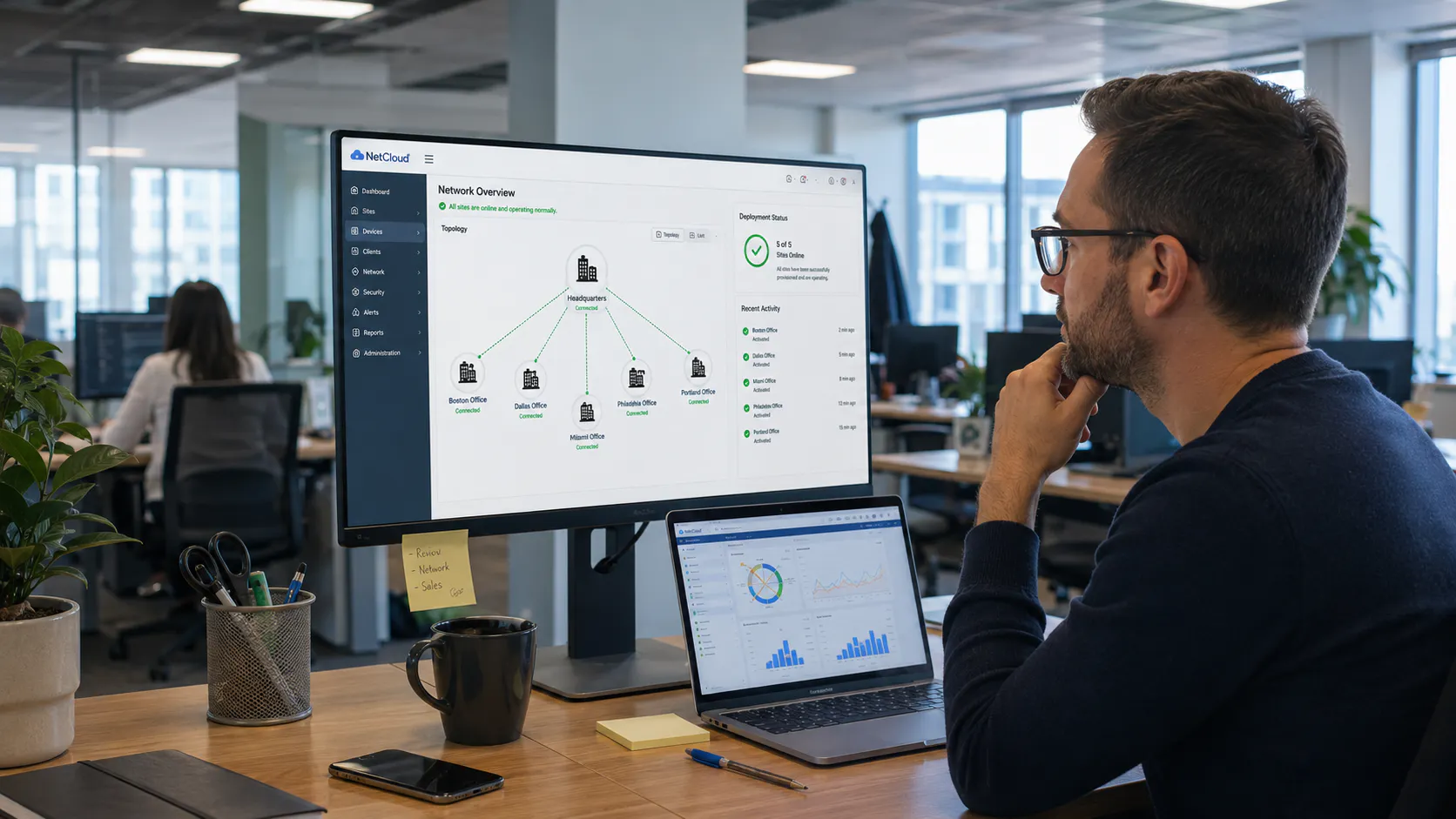
For a company managing multiple sites, this centralization primarily provides greater visibility and reduces technical operations performed individually at each location.
Q&A: zero touch provisioning
Zero Touch Provisioning, or ZTP, enables a network device to automatically retrieve its configuration when it is first brought into service. This reduces the manual operations required to deploy a router, switch, or other compatible equipment.
Traditional provisioning requires each device to be configured manually. With ZTP, configurations prepared in advance are retrieved automatically, making large-scale deployments easier.
Yes. ZTP is particularly useful when a company needs to deploy similar equipment across multiple branches, stores, or locations. It reduces local intervention and makes it easier to standardize the network.
No. The equipment and management solution must be compatible with automated provisioning mechanisms. It is therefore important to check compatibility before starting any deployment.
ZTP can be secured by protecting communications, authenticating devices, and controlling downloaded configurations. Security therefore also depends on how the provisioning platform is administered.
ZTP simplifies the initial deployment of SD-WAN equipment across multiple sites. SD-WAN then enables connections and network traffic to be managed centrally.
Simplify the management of your multi-site networks Centralize the deployment, monitoring, and management of your connections with Sewan network solutions.