Corporate IT security is based on a global approach:
- Protecting networks
- Data
- Access
- While raising employee awareness
A structured strategy is essential to limit risks and ensure business continuity.
A cyberattack does not warn you. It strikes on a Friday evening, paralyzes production on Monday morning, and generates costs no one anticipated. According to several recent studies, nearly one in two Belgian companies has already faced a cyber incident or attempt.
Contrary to popular belief, it is not large companies that are most exposed, but those perceived as less protected. Yet few of them have a truly operational security strategy.
So how can this be changed in practice?
IT security vs cybersecurity: what’s the difference?
IT security refers to the set of technical, organizational, and legal measures that protect information systems (hardware, software, data, and usage). It covers a wide scope: from workstations to corporate networks, from cloud to IP telephony.
Cybersecurity focuses specifically on digital threats: online attacks, malware, and industrial espionage via the internet.
In short, all cybersecurity is part of IT security, but IT security covers much more than cyber threats alone.
A strategy that only addresses digital risks leaves physical or organizational vulnerabilities exposed, such as:
- Shared access badges
- Untested backups
- Service providers without formal security policies
Why is digital risk still underestimated?
Everyone understands fire risk: you see the flames and measure the damage. Digital risk remains abstract until it becomes reality—and by then, it is often too late.
Key figures in Belgium:
- 48% of Belgian companies have already faced cybercrime
- 5% have paid a ransom after an attack
- Public administrations and healthcare are among the most targeted sectors
- The Belgian Cybersecurity Centre (CCB) recorded 556 cyber incidents in 2025, including 8 with national impact
Mid-sized organizations are particularly at risk: seen as less protected than large groups, yet holding valuable data.
In response, Belgium has updated its national cyber crisis plan in 2026 to improve coordination and incident response.
What are the main cyber threats?
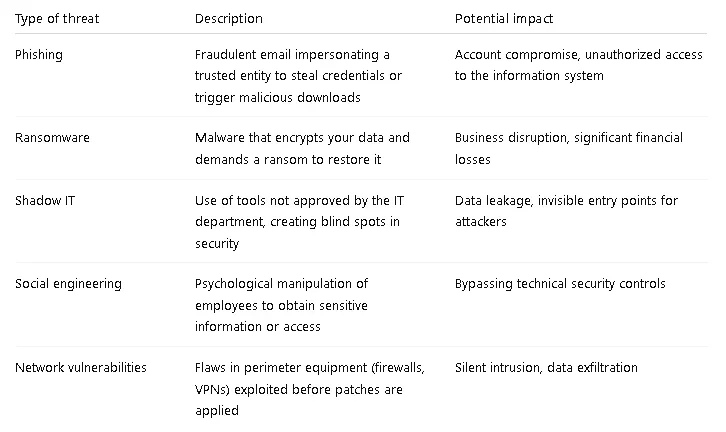
Cyber threats now take many different forms and are evolving rapidly. Here are the main types of attacks to be aware of, how they work, and their impact on your information system.
What is changing today: attacks no longer target only systems… but also your employees and the way they work.
Phishing, ransomwares and Shadow IT
Phishing remains the main attack vector. These are fraudulent emails impersonating a trusted entity — your bank, a supplier, or a colleague — designed to encourage you to click on a malicious link or share login credentials. The different variants continue to multiply: Spear phishing (targeted phishing), Smishing (SMS phishing), Vishing (voice phishing over the phone)
Ransomware encrypts your data and demands a ransom payment to restore access. Paying does not guarantee data recovery and signals to attackers that you are a profitable target.
Shadow IT significantly increases risks: when employees use tools that have not been approved by the company (personal storage platforms, public messaging apps, browser extensions), they create invisible entry points for IT teams.
Vulnerabilities can also affect edge devices such as firewalls and VPNs.
Human error: the main exposure factor
Contrary to popular belief, cyberattacks primarily target employees before systems.
In the vast majority of cases, this is not due to malicious intent, but rather lack of awareness or inattention:
- A password reused across multiple accounts
- Quickly clicking on an attachment during a busy period
- Plugging in a USB key without thinking
Attackers exploit this human factor to personalize their campaigns and make them more credible.
An email containing your name, job title, and your manager’s name instantly lowers vigilance.
And it is precisely at that moment that everything can change.
How can you build an effective protection strategy?
The four technical foundations
Securing the network and infrastructure
Network security forms your first line of defense.
Firewalls filter suspicious traffic, while network segmentation limits the spread of an attack in the event of a breach.
Secure Internet access protects both inbound and outbound traffic.
VPN/MPLS connections and SD-WAN solutions secure communications between remote sites while optimizing application performance.
Protecting and backing up data
Data protection relies on encryption. Your information becomes unreadable without the appropriate decryption key, combined with structured backups based on the 3-2-1 rule: Three copies, On two different media, Including one offline copy
In the event of an attack, this backup strategy determines whether you can recover operations within hours or within weeks.
Managing access and identities
Access management requires multi-factor authentication and applies the principle of least privilege: each employee only accesses the resources strictly necessary for their role. Monitoring credential leaks on the Dark Web further strengthens this protection.
Monitoring and responding in real time
Real-time monitoring makes it possible to detect abnormal behavior before it escalates into an incident.
A managed SOC (Security Operations Center) provides 24/7 detection, analysis, and response without requiring you to build a dedicated in-house team.
A four-step methodology
- Assessing your actual exposure
Risk analysis helps identify the threats relevant to your sector and assess their severity.
In Belgium, the CyberFundamentals framework from the CCB is now a key reference for structuring this approach. - Formalizing your Information Systems Security Policy (ISSP)
The Information Systems Security Policy defines responsibilities, procedures, and expected security measures.
It transforms cybersecurity from a purely technical issue into a shared company culture. - Deploying according to priorities
Actions are implemented based on the identified risks. Managed solutions allow Belgian SMEs to access advanced expertise without requiring significant internal resources. - Integrating security from the design phase
The Security by Design principle consists of integrating security upstream in projects. Anticipating vulnerabilities costs on average ten times less than correcting them after deployment.
Expert support: a strategic lever
Cybersecurity requires highly specialized skills.
A proper security audit analyzes your infrastructure, identifies blind spots, and delivers a prioritized remediation plan.
Personalized consulting then helps define a strategy tailored to your environment:
- Business sector
- Volume of data
- Dependence on cloud tools
- Regulatory obligations
This is the approach adopted by Sewan, combining audits, consulting, and managed solutions to sustainably secure companies’ information systems.
Continuous monitoring ensures incident detection and response while maintaining uninterrupted protection.
When evaluating a provider, certifications such as ISO 27001, Fortinet, or NIS2 remain concrete indicators of their level of expertise and security standards.
Assess your security level
Review your current security level before investing, thanks to a tailor-made audit of your infrastructure.
Request a demoEmployees and compliance: two key levers
Making every employee a security stakeholder
Technology alone is not enough. A next-generation firewall cannot protect against an employee who shares their credentials in response to a fraudulent email.
Awareness training transforms your teams into the first line of defense instead of the weakest link.
Training your teams helps them:
- Detect threats
- Adopt the right reflexes
- Reduce incidents
The objective is not to blame mistakes — they happen — but to develop a natural day-to-day vigilance.
Navigating the regulatory framework
The GDPR has governed the processing of personal data since 2018 and requires encryption, restricted access, and breach notification within strict deadlines.
ISO 27001 provides the leading international standard for structuring your information security management system.
Meanwhile, the NIS2 Directive strengthens obligations for essential and important entities: formalized risk management, accelerated incident reporting and supply chain security.
Protect your information system
Anticipate cyber threats and protect your business before an incident occurs.
Request a demo