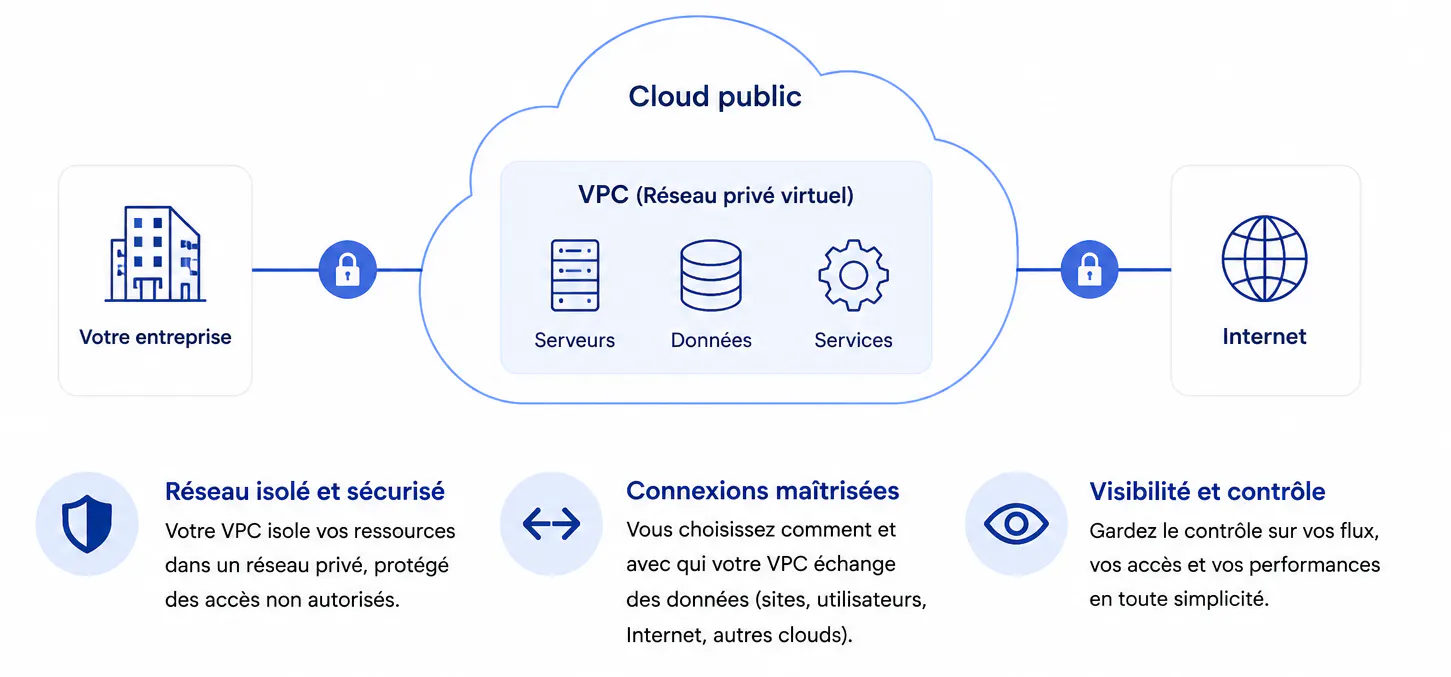
The VPC (Virtual Private Cloud) makes it possible to create a private and secure network environment within a public cloud. It combines:
The flexibility of the cloud with the control and isolation of a private infrastructure.
Thanks to private subnets, traffic segmentation and encrypted connections, sensitive data remains protected.
A VPC simplifies the management of applications, servers and cloud resources while improving service continuity.
This approach also increases agility, improves cost control and simplifies the evolution of IT infrastructure.
Migrating to the cloud without losing control of data is now one of the main challenges facing businesses. Between security constraints, compliance requirements and the need for flexibility, IT departments must strike the right balance between performance and infrastructure control.
The Virtual Private Cloud, also known as VPC, directly addresses this challenge. It allows companies to benefit from the flexibility of the public cloud while maintaining an isolated and secure network environment.
In practical terms, a VPC provides businesses with a dedicated space in the cloud to host applications, servers and sensitive data without having to manage a complete physical infrastructure. This approach appeals to both SMEs and large organizations looking for agility, security and cost control.
Virtual Private Cloud: definition and operating principles
What is a VPC?
Imagine having your own datacenter within AWS (Amazon) or Azure (Microsoft), without having to manage the technical complexity of a private network of that scale. That is exactly what a Virtual Private Cloud (VPC) delivers: a logically isolated network within a hyperscaler’s infrastructure, where your servers, databases and applications operate in a secure perimeter — connected to the internet without the usual risks.
A VPC is based on a logically isolated network within a cloud provider’s infrastructure. Your servers, databases and applications operate in a private environment, protected from external access and separated from other environments hosted on the same infrastructure.
This isolation relies on several security mechanisms:
private subnets;
dedicated VLANs;
encrypted VPN tunnels;
customized access control rules.
As a result, your data circulates within a secure environment while benefiting from the flexibility and scalability of the public cloud.
Businesses can therefore define their own network architecture, create dedicated subnets, assign private IP addresses and manage traffic flows according to their operational needs.
Security architecture explained
A VPC operates through three security layers designed to ensure complete isolation of your environment.
At network level, private subnets create a sealed environment. Your instances communicate through RFC 1918 address ranges (10.x.x.x, 172.16.x.x, 192.168.x.x), which remain completely invisible from the internet. External attackers cannot directly reach your servers or network.
VLAN segmentation adds another isolation layer at frame level. Even when several customers share the same physical infrastructure (such as Amazon AWS or Microsoft Azure), their network traffic remains strictly separated. This technique, inherited from enterprise networking, prevents any traffic leakage between tenants.
Finally, VPN tunnels encrypt all exchanges between your sites and your cloud resources. Whether IPSec or WireGuard depending on the implementation, the result is always a very high level of protection for sensitive data.
This architecture enables companies to strengthen security without sacrificing cloud flexibility.
VPC: positioning and differentiation
VPN and Virtual Private Cloud: complementary, not competing
VPNs and VPCs address two different needs.
A VPN (Virtual Private Network) is designed to secure a connection between two points. For example, it allows a remote employee or branch office to securely access company resources.
A VPC, on the other hand, refers to the cloud environment where your resources are hosted: applications, servers, databases and business tools.
In practice, the two technologies often work together:
the VPN secures connections;
the VPC hosts resources within an isolated environment.
In other words, your complete virtual datacenter.
VPC: a virtualized private cloud within the public cloud
VPC services address a very practical challenge: how can businesses benefit from the advantages of the public cloud while maintaining the isolation of a private environment?
Traditionally, operating a private cloud meant managing your own infrastructure: dedicated servers, maintenance, monitoring and security. While efficient, this approach is costly and complex.
A VPC completely changes this model. Instead of building your own infrastructure, you virtually carve out an isolated portion of a hyperscaler’s infrastructure.
The result: the isolation and control of a private environment combined with the agility, redundancy and economies of scale of the public cloud.
Your cloud infrastructure deserves a solid foundation
Sewan helps companies implement secure, sovereign and centrally managed cloud environments through a single unified platform.
The advantages of a Virtual Private Cloud for businesses
Enhanced security Your resources operate within an isolated environment with customizable access rules. This architecture complies with the strictest regulations, including GDPR and sector-specific requirements for sensitive data.
Instant scalability A VPC allows resources to quickly adapt to actual business needs. During peak activity periods, growth phases or new projects, capacities can scale without complex hardware deployments.
Better cost control The cloud model eliminates heavy investments in physical infrastructure and maintenance. Businesses can adjust resources according to actual consumption.
Optimized service continuity Cloud infrastructures rely on redundant architectures spread across multiple datacenters. This improves service availability and reduces downtime.
When to use this solution: practical examples
Sensitive applications and critical data Healthcare organizations, financial institutions and companies handling personal data often rely on VPCs to secure applications and better control access.
Hybrid cloud architecture A VPC simplifies the connection between existing infrastructures and cloud resources. Companies can progressively migrate to the cloud without disrupting critical systems.
Managing activity peaks Industries subject to strong seasonality, such as e-commerce, events or tourism, use VPCs to scale resources on demand without oversizing infrastructure year-round.
Development environments A VPC also enables isolated testing environments where applications can be developed and tested without impacting production systems, with resources provisioned on demand.
How to choose and deploy a VPC?
Criteria for selecting a Virtual Private Cloud
Several criteria should be evaluated before choosing a VPC solution.
Regulatory compliance The provider must meet the requirements of your industry, including GDPR, HDS or data sovereignty constraints. Data location in France or Europe is often a key criterion.
Performance and availability The infrastructure must guarantee high service availability and performance aligned with your business requirements.
Native security Access control, network segmentation, firewalling, monitoring and threat detection should be integrated from the outset as part of a native security approach.
Integration with your existing environment The VPC should integrate easily with your current tools, directories and monitoring solutions.
Sewan: the integrated ecosystem that simplifies deployment
Sewan offers a comprehensive cloud and telecom approach designed to simplify infrastructure deployment and management.
Sewan’s cloud hosting provides the technical foundation: high-performance virtual machines, redundant storage and a multi-operator backbone network. Our French datacenters guarantee data sovereignty and optimized latency.
Our VPN/MPLS solution establishes permanent and secure connections between your sites and cloud resources. Complex configurations become a thing of the past: everything is automated and monitored.
On the security side, Cloud Firewall, powered by Fortinet technology, centralizes traffic inspection, application filtering and intrusion detection. An invisible yet highly effective defense layer for your critical applications.
Everything is managed through Sophia, our orchestration platform. A single dashboard to provision, monitor and bill resources. Combined with our high-availability cloud storage, it provides a complete ecosystem designed for modern businesses.
Q&A: VPC
There are mainly single-zone VPC services (resources hosted in a single availability zone) and multi-zone VPC services (resources distributed across multiple zones for redundancy). Some providers also offer dedicated VPCs with physically isolated hardware resources.
Yes, the logical isolation of resources and dedicated access controls strengthen security despite the internet connection. Unlike a standard public cloud where resources share the same network space, a VPC creates a completely isolated environment.
Peering solutions make it possible to securely connect multiple environments together. This is particularly useful for multi-environment or multi-geographical architectures.
Simplify your IT operations every day
.Sewan supports businesses in deploying secure, sovereign cloud environments managed from a single platform.